Class 1 Sound Level Meter & Noise Measurement
The golden standard for sound noise level meter re-imagined with the Dewesoft approach. Easy to set up and use while ensuring maximum accuracy with certified compliance with international standards. No matter the type of acoustics measurement, a sound level meter is always at the heart of the sound analysis.
Class 1 Sound Level Meter
Class 1 sound level meter is designed to meet the requirements of IEC 61672. This standard specifies two levels of performance, Class 1 and Class 2, with Class 1 being effectively more accurate.
Within the standard are a set of performance criteria that a sound noise meter must meet and each of these has a tolerance associated with it.
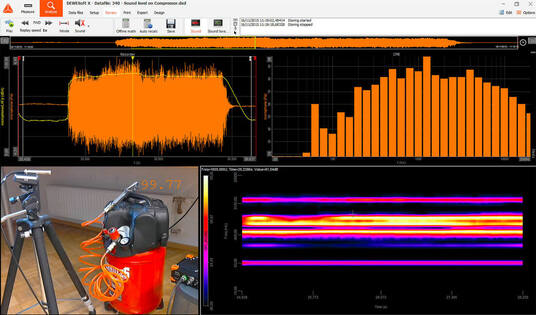
Dewesoft sound meter and sound level software module allows calculation typical parameters for the sound level measurement from a single microphone. It offers typical sound level meter calculations.
Real-time Sound Analysis
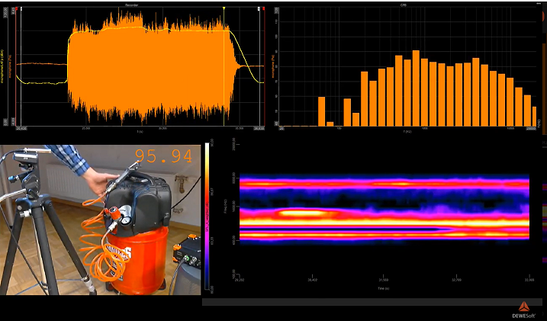
Dewesoft sound level meter solution provides real-time octave filters in order to analyze a signal and output frequency domain data. The Octave Analysis option provides a time-based real-time octave band and 1/3 octave band measurements.
Additionally, 1/n octave can be post-processed for requirements that need 1/6 octave, 1/12 octave and 1/24 octave band spectral analysis.
Microphone Calibration
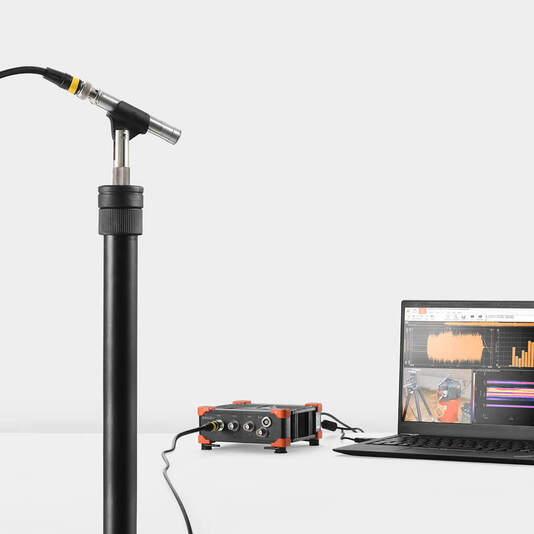
In order to make scientific sound measurements with a microphone sensor, a precise microphone sensitivity must be known. Microphone calibration will enable confidence in the performed measurements.
Since the calibration may change over the lifetime of the device, it is necessary to regularly calibrate the measurement microphone accurately.
Dewesoft allows a microphone to be calibrated in several different ways inside the Dewesoft software:
Calibration with TEDS
With an external microphone calibrator
With manufacturer calibration certificate
Dewesoft also provides professional certified IEC/ANSI acoustic calibrations for all your sound sensors.
Frequency Weighting Analysis
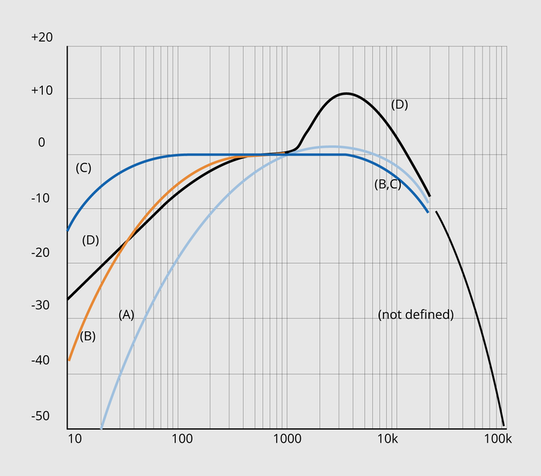
Frequency weighted noise measurements offer convenient ways to measure sound and sound frequency range. Dewesoft uses each of these frequency weighting algorithms for different type of measurements.
A-weighting is applied to measure sound levels in an effort to account for the relative loudness perceived by the human ear. The human ear is less sensitive to low and high audio frequencies.
B-weighting is the best weighting to use for music listening purposes.
C-weighting is used for high-level noise measurements.
D-weighting was specifically designed for use when measuring high-level aircraft noise in accordance with the IEC 537 measurement standard. The large peak in the D-weighting curve reflects the fact that humans hear random noise differently from pure tones, an effect that is particularly pronounced around 6 kHz.
Z-weighting is linear at all frequencies and it has the same effect on all measured values.
Time Weighting Analysis
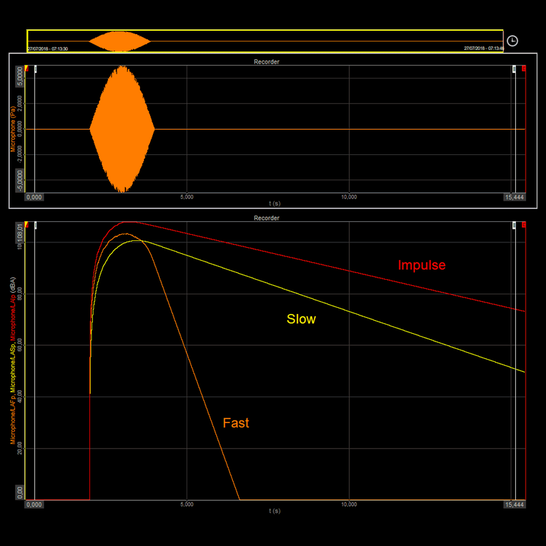
Sound level measurement using any grade of a sound level meter can be fast, slow or impulse time-weighted. These weightings date back to the time when sound level meters had analog meters and defined the speed at which the meter moved.
Fast: the needle would move fast to show quickly varying noise. Fast corresponds to a 125 ms time constant.
Slow: the needle would be damped to smooth the noise out to be easier to read. Slow corresponds to a 1-second time constant.
Impulse: the impulse time weighting is about four times faster than fast, with a short rising time constant but a slow failing constant. Impulse has a rise time constant of 35 ms and fall time constant of 1.5 sec.
Calculated Sound Parameters
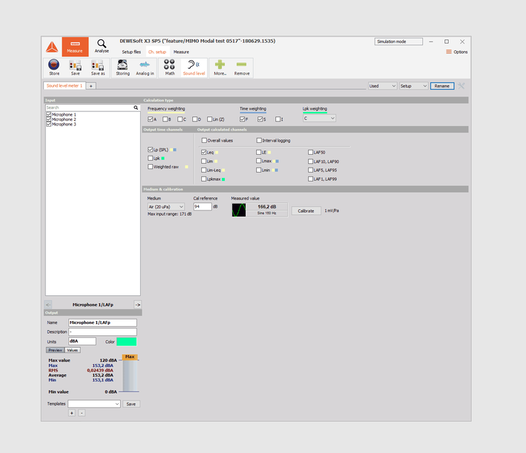
Dewesoft sound level meter calculates several parameters and channels in real-time during the measurement. Some of the automatic calculations are:
Frequency weighting / Time weighting / Lpk weighting / Frequency weighting raw / Classified sound levels / Lp (SPL) / Lim / LE
True Peak Level
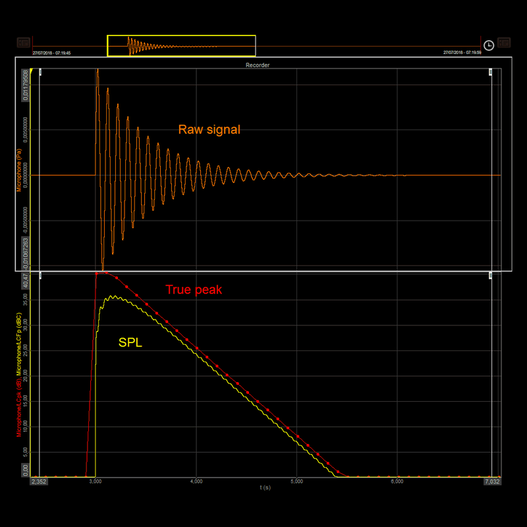
The true peak level shows the real peak value of the input signal in dB (decibel). The sound pressure level (SPL) always contains a time weighting filter, which has an influence on the peak value.
The sound pressure level does not reach that high values, no matter of we select F, S or I time weighting. The LCpk, however shows the "true peak".